Venue system design · 8 min read
Banquet Hall Sound System Design Guide for Nepal
How to design sound for wedding, reception and party venues — clear speeches, full dance music and even coverage for 300–1,000 guests.

A banquet hall does four jobs in one evening: speeches that must be understood at the back table, a band or DJ that must fill the dance floor, background music that stays out of the way during dinner, and announcements that cut through 500 conversations. Most halls in Kathmandu, Pokhara and Butwal are large flat boxes with hard floors, glass and high false ceilings — an acoustically difficult room.
A well-designed system fixes most of this without touching the building. This is the design approach we use for wedding venues, hotel ballrooms and party palaces across Nepal.
Start with the room, not the speakers
Measure three things first: the length of the room (stage to back wall), the ceiling height, and how hard the surfaces are. Length decides between a line array and point-source speakers, ceiling height decides where they can hang, and hard surfaces decide how tightly the coverage must be controlled.
Point-source boxes such as the itc KS-10H cover a hall of up to about 25 m comfortably. Beyond that, a compact line array like the itc KS-210 keeps the level far more even from the front tables to the back, because it throws further with less spill onto walls and ceiling.
Design for speech first
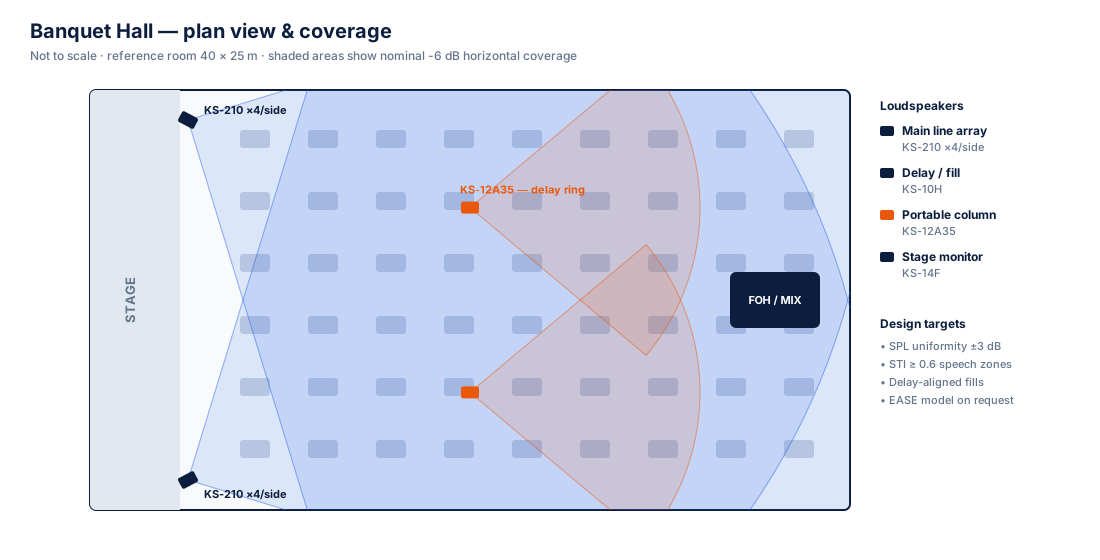
Guests forgive a slightly thin band; they do not forgive a speech nobody understood. Aim the main speakers at the seating, not the walls, mount them high enough to clear the first rows, and add delay or fill speakers in long rooms so nobody sits more than about 20 m from a source.
Wireless handhelds are the workhorse of a banquet hall. A UHF set such as the itc T-592UH covers the MC, speeches and a singer; add a lectern microphone like the itc TS-548MD for formal events.
Add the low end — carefully
Subwoofers make dance music work, but in a hard room they also make it boomy. Cluster them on the floor under or beside the stage rather than spreading them around the room, and set the crossover in the processor. One or two dual-18" subs such as the itc KS-S218 are enough for most halls up to 800 guests.
Control: simple for staff, protected from abuse
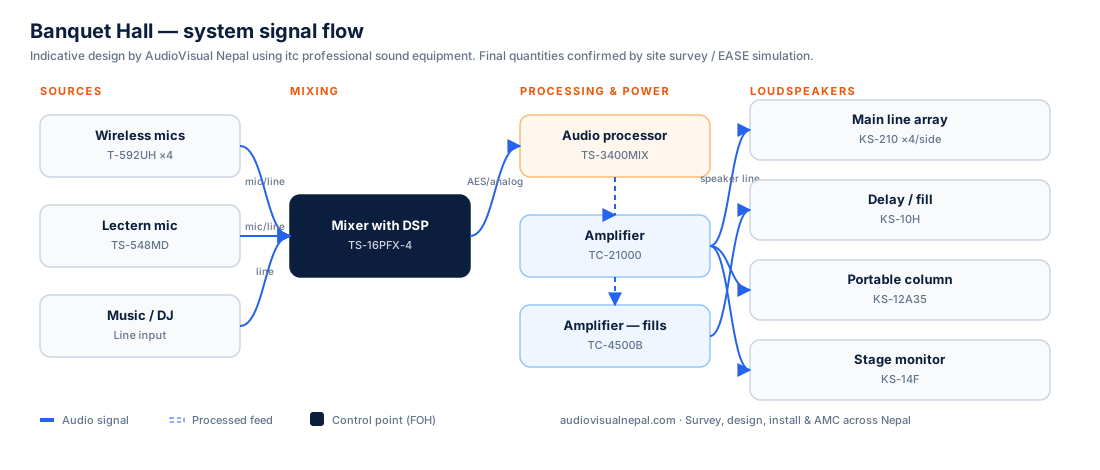
Banquet halls are run by whoever is on shift. A mixer with built-in DSP and presets — for example the itc TS-16PFX-4 — lets staff recall "Dinner", "Speeches" and "Dance" in one step. An audio processor with limiters after the mixer stops a visiting DJ from damaging the speakers.
Typical system by hall size
- Up to 300 guests: 2 × point-source mains (KS-10H), 1 subwoofer, a 2-channel amplifier, 12–16 channel DSP mixer, 2 wireless mics.
- 300–800 guests: 3–4 KS-210 line-array boxes per side, 1–2 KS-S218 subs, TC-21000 amplifiers, DSP mixer + processor, 4 wireless mics, 2 stage monitors.
- 800+ guests or very long rooms: delay speakers half-way down the room, time-aligned in the processor; a digital mixer for multi-band events.
Common mistakes we fix
- Speakers on the side walls pointing across the room — they excite the walls and smear speech.
- Subwoofers in the corners "for more bass" — they boom and drown the MC.
- No limiter — the first loud DJ night ends with blown drivers.
- Cheap wireless microphones that drop out when the hall is full of phones.
System design drawings
Indicative AudioVisual Nepal design for a typical banquet hall — signal flow and loudspeaker coverage. Quantities are confirmed on a free site survey.
Recommended equipment
| Role | Model | Why |
|---|---|---|
| Main loudspeakers | itc KS-210 line array | Even coverage to the back tables, controlled spill |
| Subwoofer | itc KS-S218 | Dual 18" low end for dance nights |
| Fill / smaller halls | itc KS-10H | Point-source main or delay fill |
| Amplifier | itc TC-21000 | 2 × 1,000 W @ 8 Ω, >95% efficient |
| Mixer | itc TS-16PFX-4 | DSP effects + presets for staff |
| Wireless mics | itc T-592UH | Reliable UHF handhelds for MC and speeches |
Frequently asked questions
How many speakers does a 500-guest banquet hall need?
Typically 3–4 line-array boxes per side plus one or two subwoofers, with delay fills if the room is longer than about 30 m. We confirm the numbers on a free site survey.
Can one system handle both live bands and DJs?
Yes — design for the DJ level and the band inputs, add stage monitors, and protect everything with a processor and limiter.
Can staff operate it without an engineer?
Yes. Mixer presets cover dinner, speeches and dance, and we train staff at handover.
Do you install and service the system?
Yes — survey, design, rigging, tuning, training and local after-sales support across Nepal.
Planning a banquet hall sound system?
Free site survey, system design and an itemised quotation from our engineers.