Venue system design · 7 min read
Conference Hall Sound System Design Guide for Nepal
Speech intelligibility first — loudspeakers, microphones, feedback control and simple operation for government, corporate and university halls.

In a conference hall the only measure of success is whether every person understands every word — the chair, the presenter, the question from row 20. Most halls we survey have the opposite problem: powerful speakers that are loud everywhere and clear nowhere.
This guide covers how we design conference and seminar halls for ministries, banks, universities and hotels: the loudspeakers that suit speech, how many microphones to plan, and how to stop feedback before it starts.
Column loudspeakers: the speech specialists
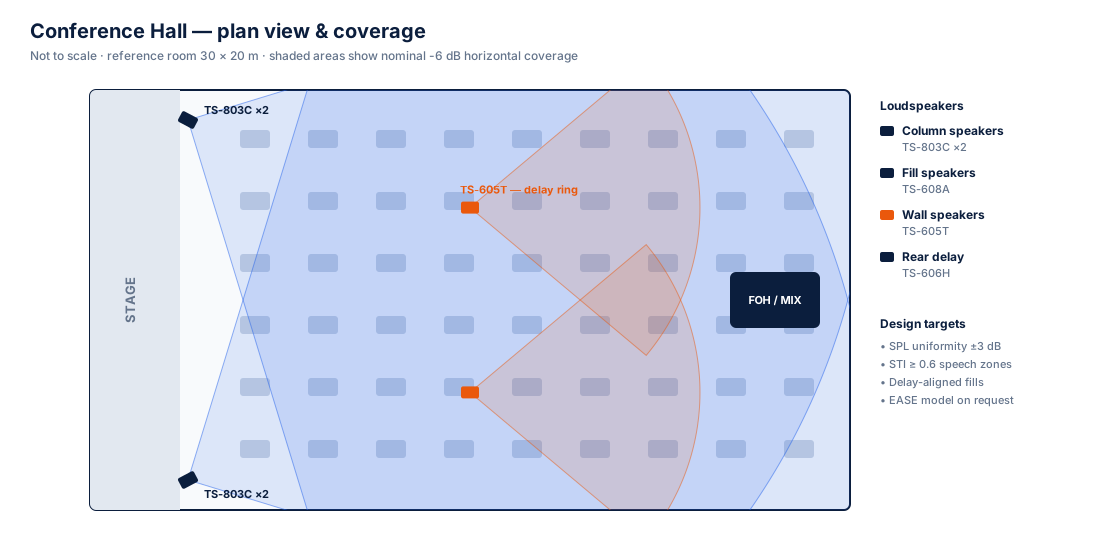
Column speakers are tall and narrow, so their coverage is tight vertically and wide horizontally — sound goes to the audience instead of bouncing off the ceiling and floor as echo. The itc TS-403C / 603C / 803C / 1203C family scales from seminar rooms (TS-403C) to 30 m halls (TS-1203C).
Under low ceilings, distributed wall speakers such as the itc TS-605T keep every listener close to a speaker without raising the level.
Microphones: one per speaker, not one per table
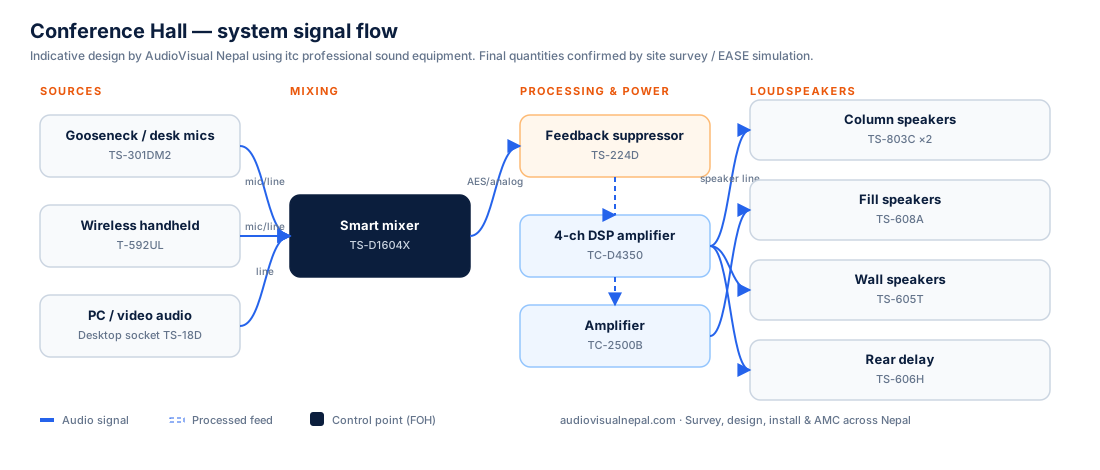
Plan a gooseneck microphone for each person on the dais (for example the itc TS-301DM2), two wireless handhelds for audience questions (itc T-592UL) and a lectern mic. For formal sessions with a chair, speaking order or voting, a digital conference system is the better choice — see our conference microphone guide.
Feedback control and DSP
Feedback — the howl when a microphone hears its own loudspeaker — is the most common complaint in Nepali halls. Keep speakers in front of the microphones, use directional mics, and add a feedback suppressor such as the itc TS-224D. A 4-channel DSP amplifier like the itc TC-D4350 adds EQ and delay per zone in one box.
Make it operable
Most halls have no sound engineer. A smart mixer (itc TS-D1604X) with a fixed gain structure and one volume control, plus labelled desktop sockets for laptops at the podium, lets any staff member run a session.
Typical system by hall size
- Seminar room (50–100 seats): 2 × TS-603C columns, 2 wall fills, a 2-channel amp, smart mixer, 4 goosenecks, 2 wireless.
- Conference hall (100–300 seats): 2 × TS-803C or TS-1203C, rear delay speakers, TC-D4350 DSP amp, feedback suppressor, 8–12 goosenecks, 2–4 wireless.
- Large auditorium (300+): compact line array (KS-210) with fills, a digital mixer, recording and streaming feed.
System design drawings
Indicative AudioVisual Nepal design for a typical conference hall — signal flow and loudspeaker coverage. Quantities are confirmed on a free site survey.
Recommended equipment
| Role | Model | Why |
|---|---|---|
| Main speakers | itc TS-803C / TS-1203C column | Tight vertical coverage = clear speech |
| Fill speakers | itc TS-605T wall speaker | Even level under balconies and in long rooms |
| Amplifier | itc TC-D4350 DSP | 4 channels with EQ and delay built in |
| Mixer | itc TS-D1604X smart mixer | Simple, preset-driven operation |
| Feedback control | itc TS-224D | Stops howl before it starts |
| Microphones | itc TS-301DM2 + T-592UL | Goosenecks for the dais, wireless for Q&A |
Frequently asked questions
Why does our hall echo even though the speakers are powerful?
Usually the speakers spray sound onto hard walls and ceiling. Column speakers aimed at the audience, plus EQ, fix most halls without acoustic treatment.
Should we use a delegate conference system?
For formal meetings with a chair, speaking order or voting, yes. For seminars and presentations, goosenecks plus wireless are simpler and cheaper.
Can the hall record or stream sessions?
Yes — the mixer provides a clean feed for recording, live-streaming or a video-conference codec.
Planning a conference hall sound system?
Free site survey, system design and an itemised quotation from our engineers.