Technology & buying guide · 9 min read
Simultaneous Interpretation System in Nepal: Equipment, Setup and Costs
What a simultaneous interpretation system needs — booths, interpreter consoles, an infrared transmitter, radiators and delegate receivers — how to size it, rental vs purchase, and who supplies it in Nepal.
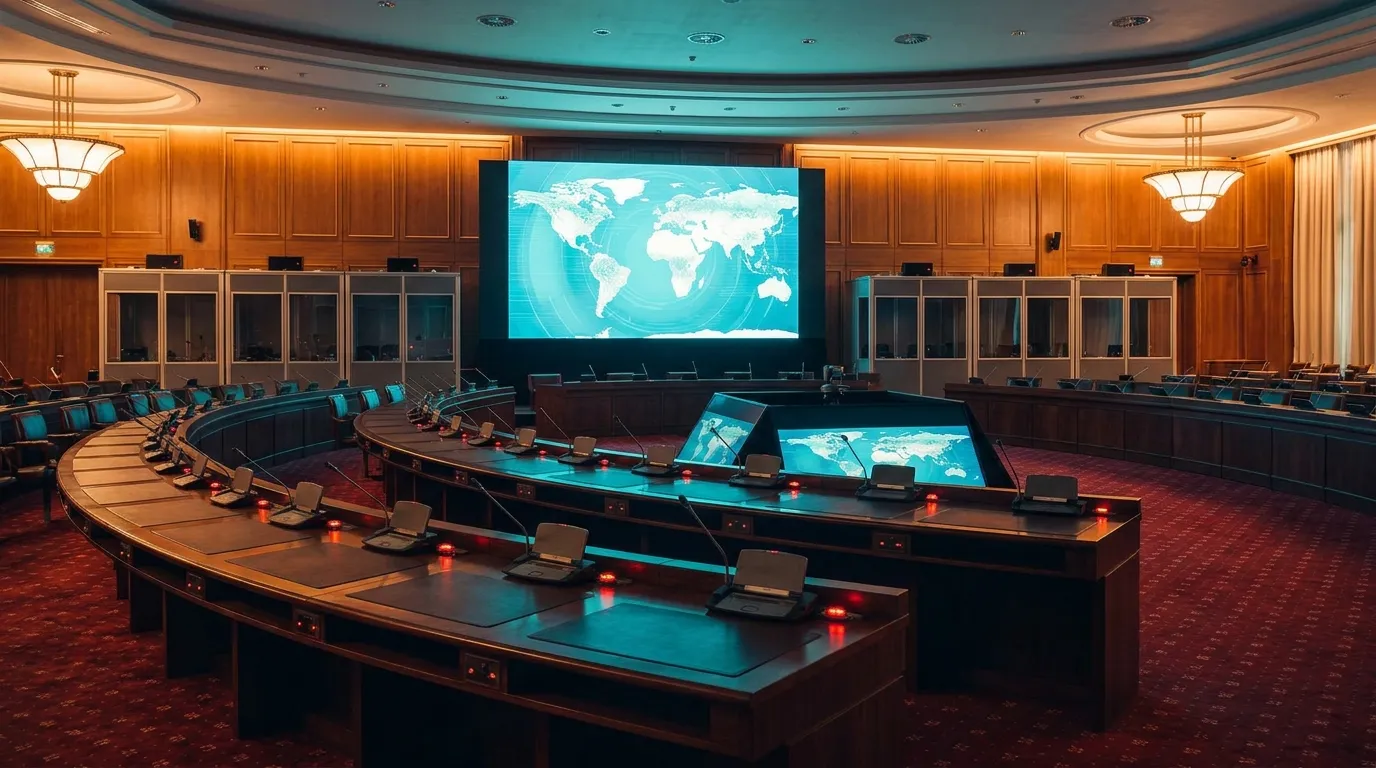
In Nepal, AudioVisual Nepal (Audio Visual Solutions Pvt. Ltd.) supplies and installs complete simultaneous interpretation systems. You need a soundproof booth per language, an interpreter console for each interpreter, an infrared transmitter and radiators that carry each language on its own channel, and a receiver with earphones for every listener.
The interpreters themselves come from interpretation agencies or freelance teams; this guide covers the equipment side — what each part does, how to size a system for your languages, delegates and room, and when renting or buying makes sense. Every system is configured to the event, so pricing is quote on request.
What a simultaneous interpretation system is
The speaker talks into a conference microphone. That "floor" audio goes to the interpreters' headphones in their booths; they interpret in real time into their own microphones, and each language is sent out on a separate channel. Delegates pick a channel on a pocket receiver — channel 0 is the original floor language, channels 1, 2, 3… carry the interpretations.
- Booths — one per target language, with two interpreters taking turns.
- Interpreter consoles and headsets — the interpreter's microphone, headphone feed, channel and relay controls (itc TS-0370HY).
- Transmitter and radiators — put every language "in the air" across the room (itc TS-0370H-8 / TS-0370H-16 with TS-0370HS radiators).
- Receivers and earphones — one per listener, with a charging case (itc TS-0370HD, TS-0370HC).
- Conference microphones — a clean floor feed; interpreters can only interpret what they hear clearly.
Interpreter booths: ISO 4043 and ISO 20109 basics
Booths isolate the interpreters from the room and the room from the interpreters. ISO 4043 covers mobile (transportable) booths — the kind set up at the back of a hotel ballroom — and ISO 2603 covers permanent booths built into a hall. Both were revised in 2024 as ISO 17651-2 and ISO 17651-1; many terms of reference still cite the older numbers, so check which edition your tender names.
In practice the standards ask for the same things: enough room for two interpreters side by side (a mobile booth for two is roughly 1.6 m wide, 1.6 m deep and 2 m high inside), good sound insulation, quiet ventilation, a wide front window with a direct view of the speakers and the screen, and booths placed at the back or side of the room on a slightly raised level.
ISO 20109 sets the requirements for the equipment itself — interpreter consoles, headphones and the distribution chain: individual volume and tone controls, a microphone-on indicator, a cough (mute) key, the ability to listen to another booth (relay), and protection against sudden loud sounds. Booths are not part of our catalogue — they are built on site or hired — but we design the electronics around them and advise on where they go.
Interpreter consoles and headsets
Plan one console per interpreter seat. The itc TS-0370HY interpreter unit has a 7-inch touch screen, a plug-in cardioid boom microphone with a red speaking indicator, a built-in speaker, a headphone jack and 5-band EQ. It connects over shielded Cat5e with uncompressed 48 kHz audio and under 5 ms delay, so interpretation stays in step with the speaker.
The itc TS-0370HYW translation station adds head-mounted microphone support and language presets that can be edited from a PC. Pair either with the itc TS-930 headset — separate listen and speak plugs, a rotatable boom microphone and a folding frame.
Distribution: infrared vs RF vs digital wireless
- Infrared (IR) — what we supply. Light-based, so the signal stays inside the room: important for confidential government and donor meetings, and no radio frequency is needed. The itc TS-0370H-8 (8 channels) and TS-0370H-16 (16 channels) are digital DQPSK transmitters to IEC 61603-7, working in the 2–6 MHz band, which avoids interference from modern LED and fluorescent lighting. Receivers need a line of sight to a radiator.
- RF (FM/UHF "tour-guide" systems) — radio passes through walls and works outdoors and on site visits, but it can be picked up outside the room, offers fewer channels and frequencies must be coordinated. We do not currently list RF interpretation kits; ask if your event needs one.
- Digital wireless / app-based — languages streamed over Wi-Fi to an app or dedicated receivers. Convenient for bring-your-own-device events, but only as reliable as the venue network. Not in our current range.
Connecting the conference microphones
The floor feed comes from the conference system. itc digital controllers such as the TS-0400M support 63+1 interpretation channels, and delegate units such as the TS-0318C let a seated delegate choose the language at their own unit — channel 0 for the floor, 1–63 for the interpreters. IR receivers then serve the observers, press and gallery who have no unit.
The 8/16 line outputs on the IR transmitter can feed a recorder, so you keep the floor and every language for the minutes. For how chairman/delegate units, voting and camera tracking fit together, see our conference system guide.
How to size a system: languages × delegates × room
- Channels = interpreted languages + 1 for the floor. The 8-channel transmitter covers up to 7 languages plus floor; choose 16 channels for larger multilingual events or headroom.
- Booths = one per target language. Interpreters = usually two per booth, three for long technical days. Consoles = one per interpreter.
- Receivers = number of listeners + about 10% spare, each with earphones (single-use covers or one set per delegate).
- Charging = one TS-0370HC case per 30 receivers; a full charge takes about 3 hours, so charge overnight before each event day.
- Radiators = enough that every seat sees one directly. Each TS-0370HS radiates at 135° with a range of up to 25 m; a small boardroom may need one, a ballroom two or more. We confirm positions on a site survey.
- Room = clear lines of sight, curtains on sunlit glass (strong sunlight reduces IR range), cable routes to the booths, and a table for receiver hand-out at registration.
Worked sizing examples
Indicative only — final quantities depend on the room survey and the interpretation agency's team plan.
| Event | Languages | Listeners | Booths / interpreters | Transmitter | Radiators | Receivers / chargers |
|---|---|---|---|---|---|---|
| Bilateral meeting in a ministry boardroom | Nepali + English | 40 | 1 booth / 2 | TS-0370H-8 | 1–2 | 44 / 2 |
| Regional conference in a hotel ballroom | 4 | 300 | 3 booths / 6 | TS-0370H-8 | 2–4 | 330 / 11 |
| International summit hall | 6+ | 600 | 5+ booths / 10–15 | TS-0370H-16 | 4+ (survey) | 660 / 22 |
Rental vs purchase
- Buy when interpretation is recurring — ministries, provincial and municipal assembly halls, convention centres, universities and hotels that host international events every month. Cabling, consoles and radiators are installed once, staff are trained, and every later event costs only the interpreters.
- For a single event, the main costs are the equipment for the days, technicians on site, booth transport and receiver hand-out and collection (lost receivers are a real cost). Tell us your dates and we will advise on the most sensible option.
- Either way, the cost depends on languages, listeners, room size and event days, so systems are quote on request — share those four numbers and we return an itemised quotation.
What hotels, UN agencies and government events in Kathmandu typically need
- Hotel ballrooms (INGO workshops, regional conferences) — 2–4 languages, 100–500 listeners, mobile booths at the back, radiators on stands, receivers issued at registration.
- UN agencies and development partners — terms of reference often cite ISO booth and equipment standards, need confidentiality (IR suits this) and a recording of the floor and each language.
- Ministries and bilateral meetings — Nepali⇄English is the most common pair; boardrooms with conference units can select the language at each seat, so receivers are only needed for observers.
- Assembly and council halls — permanent installation integrated with the conference system, with interpretation that can be switched on only for sessions that need it.
- Power — put the transmitter, conference controller and interpreter consoles on an online UPS. A generator change-over that lasts a second drops every language mid-sentence; receivers run on their own batteries.
Recommended equipment
| Role | Model | Why |
|---|---|---|
| IR transmitter, 8 ch | itc TS-0370H-8 | Up to 7 languages + floor, IEC 61603-7 |
| IR transmitter, 16 ch | itc TS-0370H-16 | Large multilingual events |
| IR radiator | itc TS-0370HS | 135° coverage, up to 25 m, cascadable |
| Interpreter unit | itc TS-0370HY | 7" touch screen, boom mic, 5-band EQ |
| Translation station | itc TS-0370HYW | Headset or boom mic, PC language presets |
| Interpreter headset | itc TS-930 | Separate listen / speak plugs |
| Delegate receiver | itc TS-0370HD | 16 channels, LCD, removable battery |
| Charging case | itc TS-0370HC | Charges and stores 30 receivers |
| Conference controller | itc TS-0400M | 63+1 interpretation channels |
| Delegate unit | itc TS-0318C | Language selection at the seat |
Frequently asked questions
Who supplies simultaneous interpretation equipment in Nepal?
AudioVisual Nepal (Audio Visual Solutions Pvt. Ltd.) designs, supplies and installs infrared simultaneous interpretation systems from the itc range — transmitters, radiators, interpreter consoles, receivers and conference microphones. Interpreters are engaged separately through an interpretation agency.
How much does a simultaneous interpretation system cost in Nepal?
It depends on the number of languages, listeners, room size and event days, and on whether you buy or need equipment for a single event. Pricing is quote on request — send those details and we return an itemised quotation.
How many interpreters and booths do we need per language?
One booth per target language with usually two interpreters who take turns; for long or highly technical days, agencies often assign three. Each interpreter needs their own console.
Infrared or RF — which is better?
Infrared keeps the signal inside the room, needs no radio frequency and carries many channels, so it suits confidential and permanent installations. RF passes through walls and suits outdoor events and site visits, but can be overheard outside the room. We supply infrared systems.
Can delegates listen on their own phones?
App-based systems exist, but they depend on the venue Wi-Fi and the delegates' phones. Our systems use dedicated infrared receivers, which work without a network.
Can interpretation be added to our existing conference system?
Often yes. itc digital controllers such as the TS-0400M support 63+1 interpretation channels and units such as the TS-0318C select the language at the seat. Tell us the controller model you have and we will check compatibility.
How do the receivers stay charged?
Each receiver has a removable lithium battery. The TS-0370HC case charges 30 receivers at once and fully charges them in about 3 hours; we recommend charging overnight before each event day and keeping 10% spare receivers.
Want an engineer to check your plan?
Free site survey, system design and an itemised quotation from our engineers.